 NodeLab×
- +

NodeLab
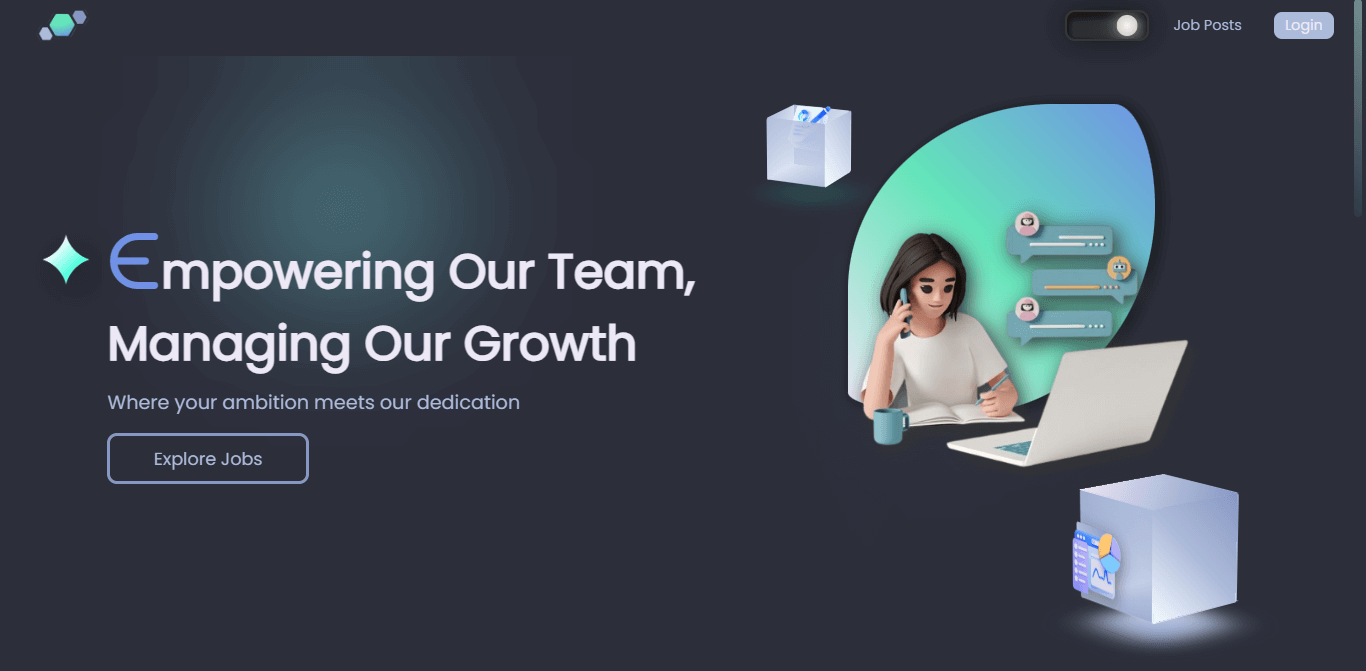
A web-based Human Resource Management System developed to streamline and automate core HR functions including recruitment, employee record management, and job listing maintenance.
The system provides three distinct access levels — Job Seekers, Employees, and HR Personnel — each with tailored features that reduce administrative overhead and improve visibility across the hiring pipeline.
The Problem
What problem?
Traditional HR processes are plagued by inefficiencies — slow recruitment cycles, unclear job requirements, and disconnected employee records that are difficult to maintain at scale.
Why build it?
As organizations grow, the lack of a centralized system forces HR teams to rely on manual workflows that lead to delays, data inconsistencies, and poor candidate experiences.
The Solution
What was built?
A full-stack HR Management System with three user roles: Job Seekers who can browse and apply for listings, Employees who can manage their own profiles and submit requests, and HR Personnel who control job postings, applicant tracking, and employee records.
How it works
Built a role-based access system where HR staff manage the full recruitment pipeline from posting jobs to tracking applicant status, while employees maintain their own profiles with limited, scoped permissions. An admin dashboard surfaces key metrics across the organization.
My Role
Group Project — 5 Members
- →Frontend developer responsible for UI implementation
- →Built the job listings interface and applicant-facing views
- →Integrated employee profile management module
- →Contributed to system design and scope definition
Process & Thinking
How I approached it
Helped generate and refine the initial project idea through discussions, feature planning, and concept development with the team.
Why this approach?
Chose a modular architecture so each HR function could be scoped and developed independently, allowing team members to work on separate modules without creating dependencies that could slow down development.
Key Insight
💡 Discovered early that most small farm operations like Flor and Daisy's still rely on manual headcounts and paper records for tracking hired workers. Building a structured employee management module meant digitizing a process that had no existing system — requiring careful thought on what data to capture and how to surface it usefully.
Tech Stack
Key Decisions
·Adopted a role-based access control model to cleanly separate Employee and HR Personnel permissions without overlap.
·Used a relational database to maintain structured records for employees, job listings, and applicant tracking with referential integrity.
·Designed the admin dashboard as a read-only overview layer to avoid permission conflicts with HR-managed data.
Architecture
No diagram provided
Features
Job Posting Management
HR personnel can create, update, and delete job postings with full details, title, department, required skills, and experience level, keeping listings accurate and up to date.
Applicant Tracking
Track job applicants from initial application through to hiring, with status updates managed by HR staff throughout the recruitment pipeline.
Employee Management
HR personnel can add new employees, update their records, and remove or terminate them from the system — keeping the employee roster accurate as the organization changes.
Administration Dashboard
A statistics overview showing total registered employees, active job listings, and applicant summaries, giving HR staff a quick insight on organizational activity.
Challenges & Learnings
Challenge
Defining clean permission boundaries between the three user roles without creating overlapping access or leaving security gaps.
Learning
Enforced role-based access at the API level rather than just the UI, ensuring employees could never reach HR-managed data regardless of how requests were made.
Challenge
Simplifying the applicant tracking process while keeping each hiring stage organized and easy to follow.
Learning
Implemented a status-based tracking system with defined stages such as Pending, Approved, Rejected, and Recruited, giving HR staff a clear view of where each applicant stands in the pipeline.
Challenge
Balancing employee autonomy with data integrity, allowing self-service profile updates without letting employees modify HR-controlled fields.
Learning
Split the employee profile into editable fields (username, fullname, contact info, passwords) and locked fields (job title, department, start date), controlled entirely by HR.
Results & Outcome
Deployment
Completed - Local
Users
Academic Group Project